
The Way of the Great Lake Salmon
Part I: A Chance Encounter at Shalda Creek
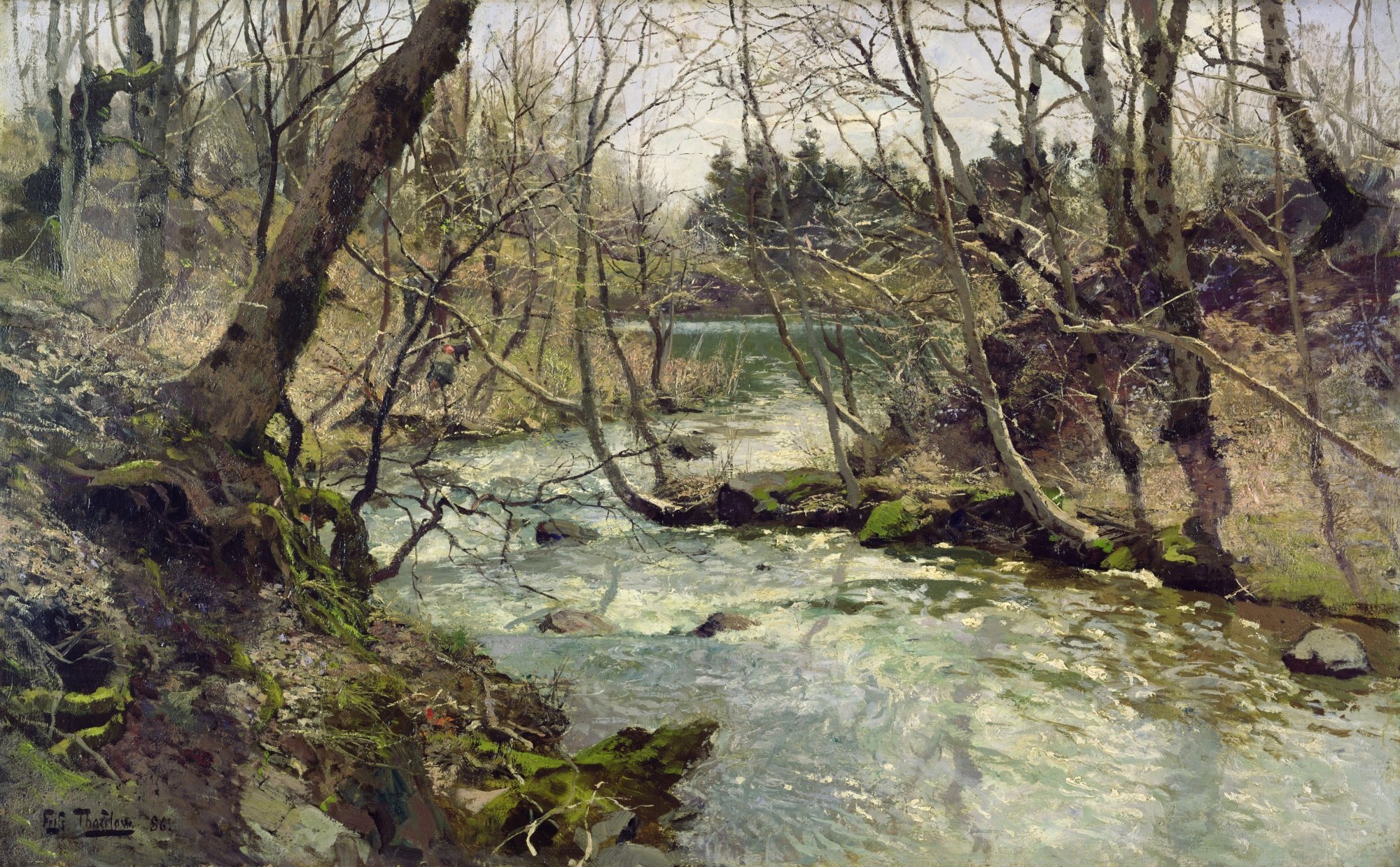
Thaulow, Fritz. River, 1886. Oil on Canvas. KODE Art Museums and Composer Homes (Bergen, Norway).
The following essay is Part One of a series about remythologizing the waterways of Northern Michigan. Overall, this series explores the power and potential of Lake Michigan’s imported salmon population to offer mythic understandings of place and belonging, especially for those of us who are the descendents of non-indigenous, immigrant peoples.
It’s late fall–sometime in November. The leaves from the sleepy trees have all nearly fallen to the cold ground below. They crunch under our footsteps, a brittle symphony that echoes through the crisp air, telling of winter days soon to come.
My wife and I are walking a section of dirt road that runs parallel to Lake Michigan, on route to one of our favorite beach hikes in the place we call home: the northwestern corner of Michigan’s lower peninsula. Along the way, the road crosses over Shalda Creek–a shallow rivulet that flows northwest out of Little Traverse Lake through nearby swamps and woodlands before ultimately spilling out into Good Harbor Bay. As always, we stop to admire the creek. Its waters are dyed a translucent rusty-brown from the tannins of the fallen leaves, like a naturally-brewed stream of burbling iced tea. The grasses along its banks are wet and heavy, but still green, holding on dearly to their numbered days.
We take a quick detour along an informal trail that follows the creek inland and away from the dirt road. We don’t make it far, however, before the trail disappears altogether into the swampy interior. We turn back, intent on ambling towards our original destination, when we notice a large, dark shape in the water. We creep forward to get a better look.
Staring up from the shallow depths of Shalda Creek is the largest salmon we’ve ever seen. Bearing in mind that recollection has a way of distorting our judgment–especially, for whatever reason, when it comes to fish–I’d venture to say it was about three feet in length and around thirty-five pounds in weight.
In any case, it’s well past high season for the annual salmon run–that period of time between September and October when mature members of the species take their final journey en masse from Lake Michigan up the many rivers and streams that lead back to their ancestral spawning grounds. It’s rare, though not unheard of, to spot a salmon at this time of the season, and it’s clear to see why this one is still wading in the icy waters of the creek.
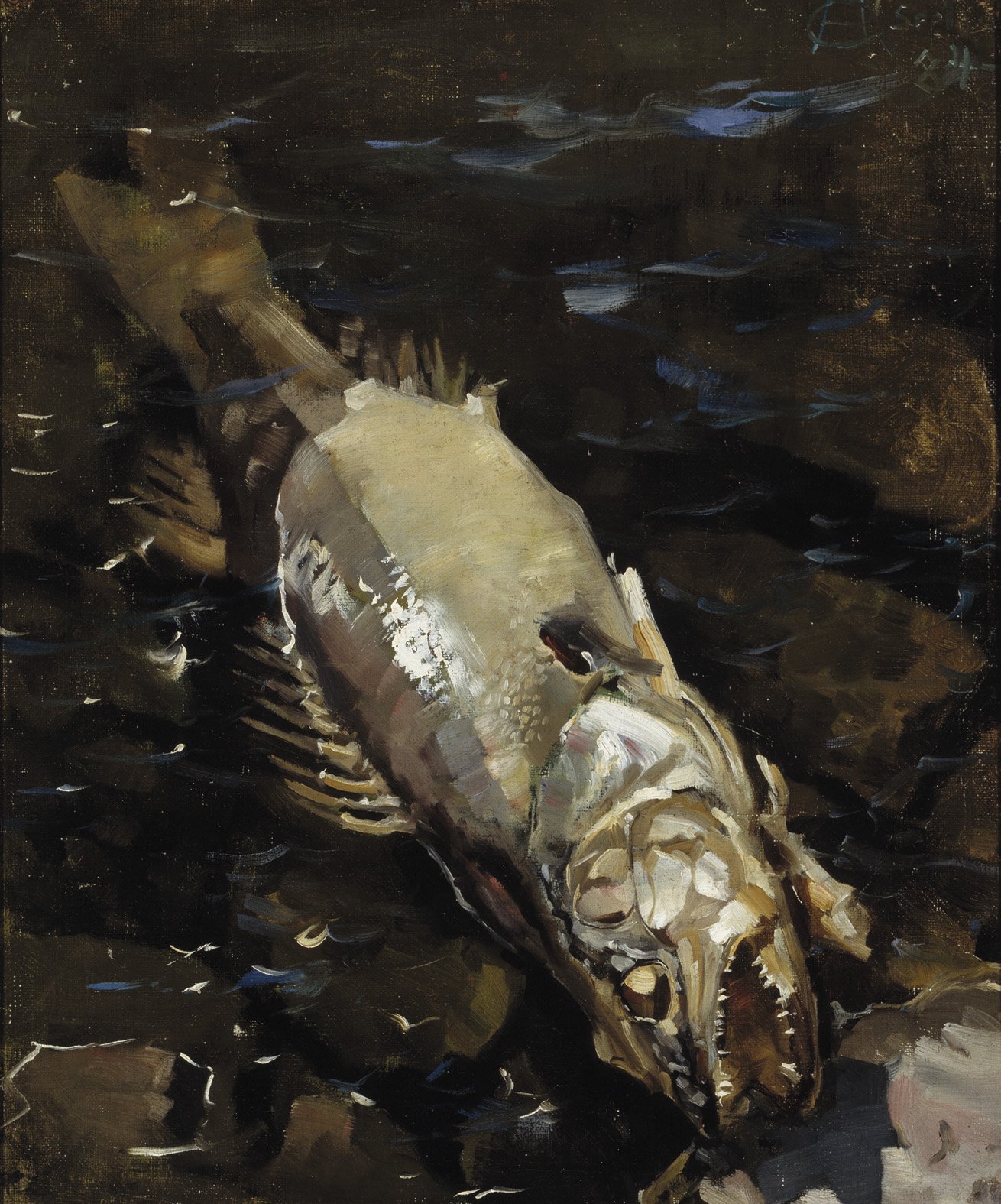
Gallen-Kallela, Akseli. Decaying Sander, 1884. Oil on Canvas. Ateneum (Helsinki, Finland).
Its massive flanks are a dark, muted gray and lined with scars–tales from the cold, blue depths of Lake Michigan literally transcribed onto its flesh, which appears to be rotting in parts. The salmon stares up at us with its yellow, dying eyes. Worn and tired though this fish may be, it also looks damn-near primordial, a passing embodiment for that ancient, raw, and powerful force that animates the beautiful and cyclical life of its species.
My wife and I stand in awe, neither one of us wishing to move. It’s one of those moments where time seems to stand still. The salmon matches our gaze and refuses, for whatever reason, to move upstream. Eventually, we conceded the stream to the fish, continuing our hike down the dirt road and toward the beach.
I reflect often upon that encounter with the salmon: why it happened and what it might mean. History and biology, no doubt, can provide a relatively adequate explanation for the why of it all. Pacific salmon were first introduced to Lake Michigan in 1966 as a means to control the dangerously invasive alewife population and, on the whole, the species has done quite well at adapting to its new home. It was only a matter of time before my wife and I, both avid hikers, came across a straggling salmon, unable (or perhaps unwilling) to complete the final journey upstream to its spawning grounds.
And yet, while this explanation may be factually true, it proves wholly inadequate at prescribing any meaning to such a visceral experience: the chance, almost mythic encounter with that primeval beast, an emissary of his or her own species left behind in the freezing waters of a tiny creek in northwestern Michigan as if to show me something. But what?
A part of me–that rational, disenchanted part formed in the knowledge factory of modern secular society–says I shouldn’t presume to know what, if anything, a dying salmon might have been trying to tell me. It is, as the prevailing common sense of scientific materialism would have it, just a complex, but ultimately meaningless, assemblage of atoms performing its biological functions that I happened across one day. Then again, as the playful Chinese sage Zhaungzi once suggested, who are we to know what we do or don’t know about the inner lives of fish?
And so, I venture out beyond the familiar and utilitarian pastures of the modern, desacralized worldview so endemic to our times; further up and farther in, to channel C. S. Lewis, to some illusive place our ancestors once knew, but too many of us have long-since forgotten; to something beyond a worldview that’s as hard and cold as the November ground upon which I stood that day; something more ancient but, paradoxically, also more present; forged in the age-old fires of myth, yet wedded to this place and this time that the salmon and I now call home.
In the waterways of northern Michigan, the salmon, too, are far from the place their ancestors once swam–not to mention the indigenous communities that venerate them to this day. Nonetheless, these fish are still sacred, and they have much to teach us, especially those of us who are, like these majestic creatures, the descendents of non-indigenous, immigrant populations. They have a seemingly innate capacity to reveal not only the wonder and horror of the local world we cohabitate, but also how to relate to that world in ways that are humble, reverential, and perhaps most importantly joyful at times.
When I reflect upon my many encounters with these Great Lakes salmon, truths that otherwise would go unnoticed gradually come to me in the periphery of my mind’s eye. These truths are hard-won and not always readily or openly discussed–the most important kind of truth! They are, if you will, slightly out of place and carried upstream, against the current like a Pacific salmon on a crisp fall day in coastal northern Michigan.
D. M. Garzonio

Dominic Michael Garzonio is a denizen of the North American Midwest. Born in southern Ontario, he was raised in the suburbs of Chicago and came of age amidst the cornfields of central Illinois before settling down in his adopted home state of Michigan. He’s a washed-out academic who holds a Master’s degree in History from Illinois State University and a PhD in American Culture from the University of Michigan. He proudly resides in the smallest of Michigan’s 83 counties with his loving wife and their two wild sons and is known to occasionally wander the local hills with homemade mead in search of gods, spirits, and the countless other treasures modernity has robbed us of.