
Monsters and the Mythic Land: Here be Giants
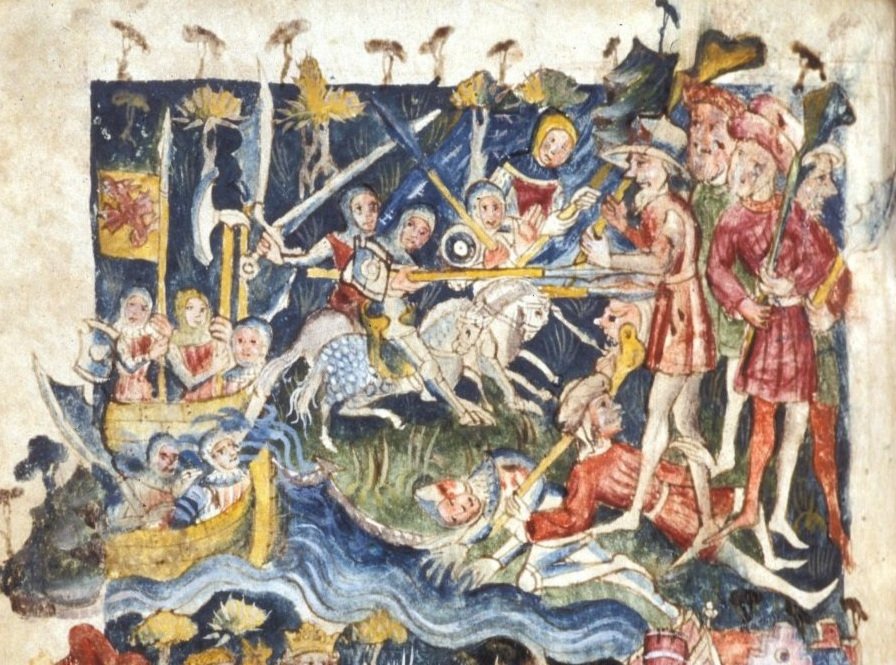
“Combat between Brutus's troops and the giants led by Gogmagog” (Wikicommons).
In the summer I visited Malham cove in Yorkshire. It’s a beautiful place, an off-white cliff formation of limestone. When you stand at the bottom and look up, although it’s only around 70 metres high, it’s easy to feel small, dwarfed by it. There’s a short if not steep walk up to the top, well worth it for the views of the surrounding landscape. And again, you can’t help but feel dwarfed by the magnificence of it all. Anyone who likes to escape the towns and cities and really explore the wild places of hills and mountains, of deep forests and vast seas, will know that giants are real. When out in such places, it’s easy to feel small, the reality of our size cannot be denied. In part, it’s why I enjoy escaping into nature, an apt reminder that my problems are small in comparison to the vastness of nature.
Part of my love for nature and the wilds extends to stories, in particular folk stories and folklore. I think the allure of such stories is that they allow us to explore the wild places and nature without minimising it, or making it seem ordinary and everyday. They also tell us something of ourselves, if the monster exists in the land, then it also exists within us. Folklore and folk stories don’t gloss over that fact.
In research for an upcoming project, I’ve been meeting a lot of monsters lately. What is particularly fascinating, to me at least (and hopefully to you too), is that these monsters are found in the landscape, they inform our understanding of places, and as much as the landscape inspires the stories about them, the monsters also offer insight into the land, offering us a mythic perspective that is just as important as the geography of it, and I might argue, just as real.
The dictionary definitions of the word ‘monster’ are what you might expect. A monster is a large, frightening creature, often described as ugly (though perhaps ugly is not quite right, perhaps to be monstrous in looks is to be so spectacularly different to the norm), extraordinary, daunting and frightening. As a verb, to ‘monster’ someone might be seen to criticise or reprimand. To describe someone as being monstrous is to call them cruel or unfeeling. All of these definitions are useful when we consider the monsters within the landscape and within ourselves too.
In the stories, the monsters are usually overcome by some hero, who in order to overcome the monsters also becomes monstrous, sometimes for the duration of the task, and sometimes it is already within them, lurking beneath the surface. This is the truth of such myths. They highlight the duality of the monster and the human and, in doing so, create a relationship with the land that shapes our understanding of it, ultimately of ourselves too. If I’m honest, there's a part of me that feels sorry for the monsters, creatures that simply exist within a place, and are killed and displaced by the hero and their people. Perhaps one could go as far as to suggest that the issues that seem to form the headlines today aren’t new at all; that myths, legends, folklore and stories are but a mirror image of the world today.
The tale of Gogmagog, as recorded by Geoffrey of Monmouth in his 12th century Historia Regnum Britannae (The History of the Kings of Britain) seems to reflect these thoughts well, of the giants of land and the will of man to overcome, of homelands and distant places, and the desire to call somewhere home. Sometimes, in these stories, it is hard to tell who the monsters are, or if there are any true monsters. Whether this story leads you to question such ideas or not, it does show that the land is as much shaped by myth as by other perhaps more tangible forces. It is this power of the mythic that draws me to such stories and lore.
Before Britain was known as such, it was called Albion, named after the princess Albina, who ruled the land with her sisters. The sisters themselves might be seen as witches, in that they threw off the shackles and expectations of society and were cast out of Syria for plotting to kill their husbands forced on to them by their father. After a long time at sea, they landed on the shores of what would become Albion, later Britain, and there became wild things. As with many a story of a similar vein, they became if not lonely, then definitely horny, and sensing the desire of the sisters, the devil sent demons to them, and so the sisters satiated that particular thirst. And as surely as night follows day, as one might imagine, they became pregnant. The sisters birthed unto the land, a race of giants, and it was these giants from which Gogmagog was descended.
Anyhow, many years later, new travellers found themselves on Albion’s shores. The leader of this group was Brutus, they claimed the land for themselves, and this is from where Britain, according to folklore, gets its name. But of course, the land was already inhabited, and the giants did not want to share it or its wealth with the newcomers. Needless to say, Brutus and his men waged war against the giants, and despite their strength and size, soon the landscape was littered with the bodies of slain giants, all except Gogmagog, who was bound. While tied and tethered, Gogmagog spoke the story of his kin and forebears to the newcomers.
After learning all he could, Brutus challenged the strongest of his men, Corineus, to a wrestling match with the giant. You’d think the giant would win, wouldn’t you? But of course, that is not the way with such stories! The fight between giant and man lasted a long time, and eventually, the giant took control, breaking three of the warriors’ ribs. Alas, in true Rocky Balboa style, the pain and fear seemed to empower Corineus, so that with a newfound strength and energy, he hefted the giant above his head and hurled him from the cliffs, into the sea. As his reward, Corineus was given land to call his own, which is how Cornwall got its name.
As for Gogmagog, well, many believed he died, but can beings such as him really die? In other lore, Gogmagog became two beings, Gog and Magog, the giants that are said to guard the City of London. Of course, you cannot escape the biblical stories of Gog and Magog, fierce and powerful beings of chaos who symbolise the eternal struggle between good and evil.
This change and splintering of stories, that become refracted in many ways, is also what draws me to folklore, and perhaps offers a truth into the mythic landscape and the many ways in which we interact with it, even when we may not know or be aware that we are. This is the way in which stories connect us with the land and with ourselves – the monsters that reside within both!
Emma Kathryn

Emma Kathryn practises traditional British witchcraft, Vodou and Obeah, a mixture representing her heritage. She lives in the sticks with her family where she reads tarot, practises witchcraft and drink copious amounts of coffee.
You can follow Emma on Facebook.