
COP30: The struggle to end the fossil fuel age
Belém — At COP30, the Indigenous peoples of the Amazon arrived first, before the heads of state, before the buttoned-up delegations, before the promises of energy transition that often end in transcripts of speeches in inboxes. They came because the forest is suffering, because its rivers are being polluted, its fish are disappearing, and its children are getting sick because of an energy model that continues to sacrifice entire territories in the name of progress that never reaches those who live in the forest. They came because they know that if the world truly wants to end the era of fossil fuels, that end begins in the Amazon.
When the water runs out and the gas arrives
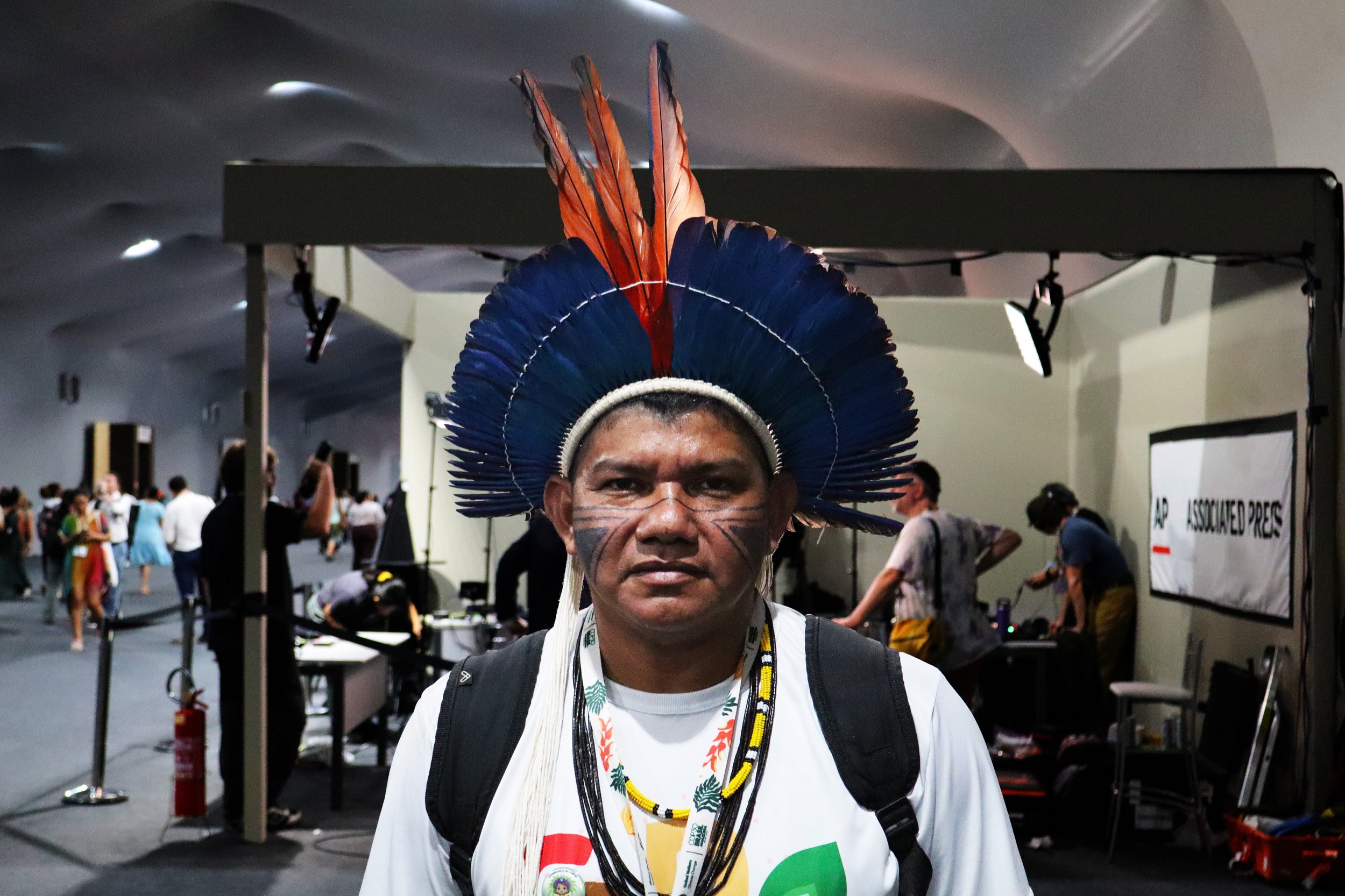
Jonas Reis de Castro, photographed by Mirna Wabi-Sabi.
During the ClimaInfo Institute's press conference on the "beginning of the end of the fossil fuel era at COP30," on November 14th in the Blue Zone, Jonas Reis de Castro, from the Silves region in Amazonas, explained with surgical precision what it means to live next to a gas well. His words illustrate the gravity of the situation:
“We are running out of drinking water, we are running out of fish, we are running out of our forest, which is being destroyed to establish mining operations within Indigenous lands.”
The impact is not only ecological, it is civilizational. Jonas describes respiratory illnesses caused by burning gas, animals fleeing the noise of the machines, and the breaking of ancestral ties to the territory—ties that cannot be restored with financial compensation.
He insists on the urgency of “exclusion zones,” areas free from any exploitation, essential for his people to continue living. This is not about radicalism, it is about survival.
“The exclusion zone… protects life and territories, and it is our future.”
While some discuss the energy transition in terms of AI, carbon credits, and 2050 targets, Indigenous peoples discuss it in terms of rivers, forests, bodies, and historical continuity now.
The Continental Strength of Indigenous Women of the Amazon


At the Amazon Watch press conference on an "Amazon Free from Extraction" and for "an end to oil, gas, mining, and agribusiness exploration on Indigenous lands," Melva Patricia Gualinga, from the Women's Earth and Climate Action Network, offered a cosmogonic perspective, reminding us that the climate crisis is not just environmental, but spiritual.
"In the forests that are alive, in those forests that still exist, trembling and saying: we don't want this life and this planet to be destroyed. Therefore, we can no longer continue with an obsolete model that has proven ineffective both globally and economically."
Melva points to the deadly contradiction of COP30, where governments that present themselves as "climate leaders" continue to expand oil frontiers, including in the Amazon. She directly criticizes the discourse that it is still necessary to extract oil for a "just transition":
"The fossil fuel-based model has already given all it had to give, it no longer works. It has to change, because if we don't change, we will exterminate ourselves."
The statement echoes a reality that science already recognizes, but that governments are reluctant to address. There is no possible transition while new frontiers of exploration are being opened.
Political Agents at the Crossroads of Energy Expansion

Marina Silva, photographed by Alice Hsieh.
Brazil’s environment minister Marina Silva has not publicly positioned herself for or against oil exploration at the mouth of the Amazon River, and insists on the technical rigor of the licensing process. Thus, her positions avoid clashing with the broader political project of the government and Petrobras, which continues to defend exploration in the Equatorial Margin, including in the vicinity of indigenous territories and sensitive areas of the Amazonian coast.
Marina has already stated that it is impossible to reconcile fossil fuel expansion with climate goals. The Equatorial Margin requires caution, and Brazil must lead the energy transition to avoid repeating mistakes already made by the Global North. Even so, her ministry continues to support the advancement of the offshore industry in the name of profit. Indigenous demands such as oil-free zones, the removal of intruders from territories, and blocking the Equatorial Margin have not yet found in Marina a moral ally, or sufficient political force to confront the fossil fuel exploration lobby. The minister's presence at the COP30 negotiations is constant, but the pressure from the communities is even greater, demanding actions beyond speeches.

Sônia Guajajara photographed by Mirna Wabi-Sabi.
Sônia Guajajara, Minister for Indigenous Peoples, expressed years ago her "concern about oil and gas exploration in the Amazon Basin," but unfortunately her statements had little to no impact. At COP30, her speeches have revolved around indigenous representation at the event and in climate decisions, but it seems there is not much she can do or even say about the expansion of the energy frontier into the territories of native peoples. Representation has not guaranteed influence.
In theory, ministers have a crucial role in a country's public administration. However, in this case, the management of specific areas and the implementation of public policies are subject to the power of global extractive industries, leading people in high-ranking government positions to predictably abandon their ideals.


Helder Barbalho, governor of Pará, spoke at the COP Village, presenting himself as an ally of natives, celebrating institutional partnerships, the creation of the Secretariat for Indigenous Peoples, headquartered in "the most sustainable building in Brazil," and the fact that, for the first time, there is an official space for indigenous delegations at COP30. Ernst & Young, a multinational company based in London, is partnering with the Government of Pará to create EY House, a space that will function as a sustainable business center for COP30 and will become the future headquarters of the Secretariat for Indigenous Peoples of Pará (SEPI) after the event. In this institutional partnership with the Government of Pará, the British 'professional services' firm promotes its visibility and reinforces EY's image as a company committed to the climate agenda and the empowerment of native populations.
While the governor adopts a tone of recognition and promise regarding policies such as indigenous education and participation in the bioeconomy and the carbon market, the discourse reveals a search for political legitimacy, insisting that indigenous people need to "take a stand" to prevent resources from being used to "benefit foreigners." This reinforces a logic of instrumental use of indigenous peoples for economic agendas, in dialogue with the global market, where native peoples are encouraged to integrate into a system that has degraded their traditional ways of life.
“From here on out, this place is going to burn.”
“It’s hurting us, it’s drying up,” said a Kaiowá representative at the COP Village.


Indigenous artisans took to the microphones before the governor arrived to speak out about the difficulty of accessing public resources such as grants and public fairs, and of implementing business councils from Sebrae (Brazilian Micro and Small Business Support Service). Bureaucracy simply excludes them, and the degradation of nature forces them to buy things that they previously extracted sustainably from nature. They pointed out how there is a taboo in talking about spirituality. Indigenous women from various lands and communities cried while speaking about their realities and what it means for them to see their lands and agendas become a stage for global narratives and interests. Their suffering is not yet highlighted, but it goes beyond urgency. The effects of global warming are visible to them now; for years they have been planting out of season and adapting to the degrading changes they did not cause.
The COP Village, despite being symbolic, represents only the minimum. Indigenous peoples deserved far more than this basic structure and these neoliberal promises. The representation offered risks serving as a political accessory, not as real decision-making power.
The Oil of the Amazon and Israel
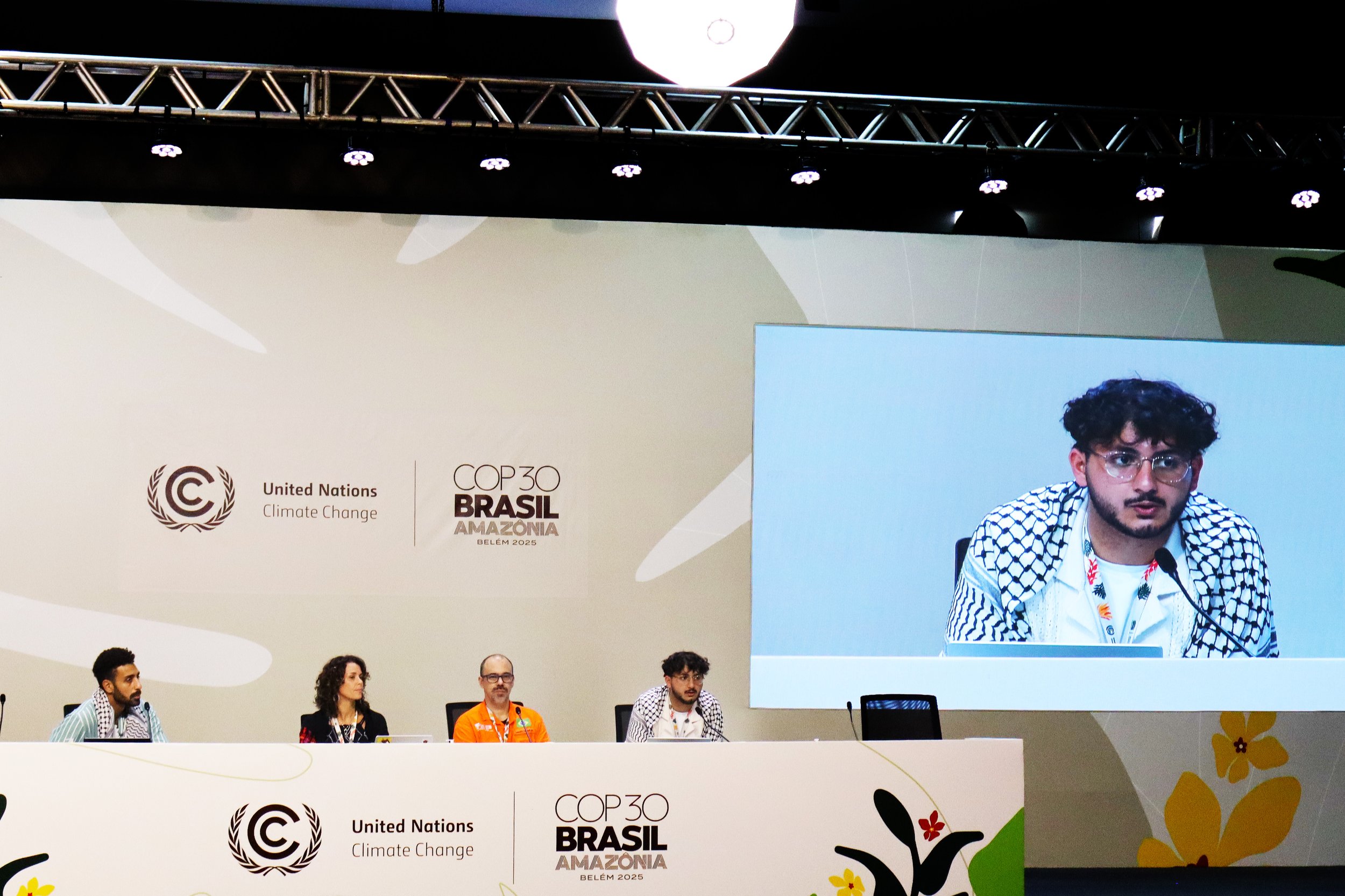
Oil Change International press conference, photographed by Mirna Wabi-Sabi.
One of the strongest parallels that emerged during COP30 came from the Oil Change International press conference on November 13th, when participants denounced the role of oil in sustaining the genocide of the Palestinian people with the launch of the report Behind the Barrel. When someone asked if there was a “legitimate use” for the fuel sent to Israel, the answer was that the question ignores the history of the establishment of the Zionist state, and there is no civilian use of fuel in Israel because that fuel goes to illegal settlements.
The criticism was forceful—barrels of oil carry “pools of blood” in their wake.
The occupation of Palestine and the destruction of the Amazon share the same extractive and colonial logic. Both transform living territories into sacrifice zones, whether it's a refugee camp in Gaza or a riverside village in the Middle Solimões. If oil fuels drones and tanks in Gaza, it also contaminates Amazonian rivers and silences birds in villages near gas wells. The indigenous struggle and the Palestinian struggle converge on the same diagnosis that the fossil model is incompatible with life.
The Role of Oil Workers

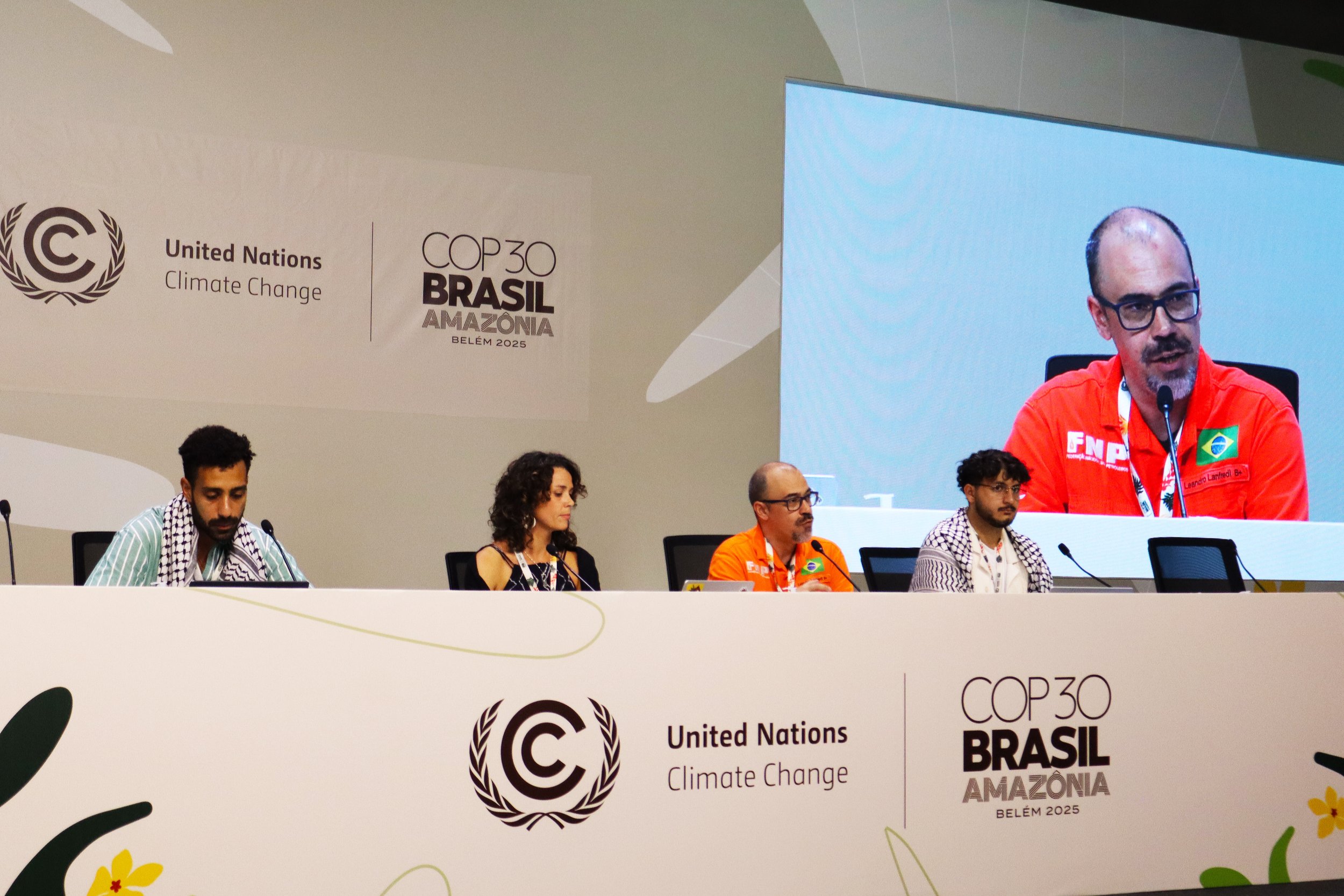

During the press conference held by Oil Change International, Leandro Lanfredi, from the National Federation of Oil Workers (FNP), presented a statement exposing Petrobras' contradiction. He explained that Brazil does not sell crude oil directly to Israel, but that Israel imports refined products from European refineries that use Brazilian oil.
“In the long term, 5 to 10% of what Israel consumes is Brazilian oil. And of that oil, Petrobras was responsible for 67% in June… Our products, our oil, are contributing to the continuation of a genocide.”
According to him, Petrobras tries to hide shipments that end up supplying Israel, using “ship-to-ship” operations in the Mediterranean:
“They try to hide their business to hinder our actions and the fulfillment of what we voted for in our Congress, which is to not want any oil shipments to Israel.”
Lanfredi's speech is a milestone as it reveals that workers in the fossil fuel sector in Brazil are positioning themselves against the use of Brazilian oil for military and genocidal purposes. It indicates that the debate on energy transition is not just environmental; it is also moral, union-related, and geopolitical. The FNP, historically a defender of energy sovereignty, is now confronting the hypocrisy of a Petrobras that sponsors COP30 with Diesel R (renewable) while simultaneously deepening the fossil fuel frontier and indirectly fueling war crimes.
The March on the 15th and the Amazon in the City
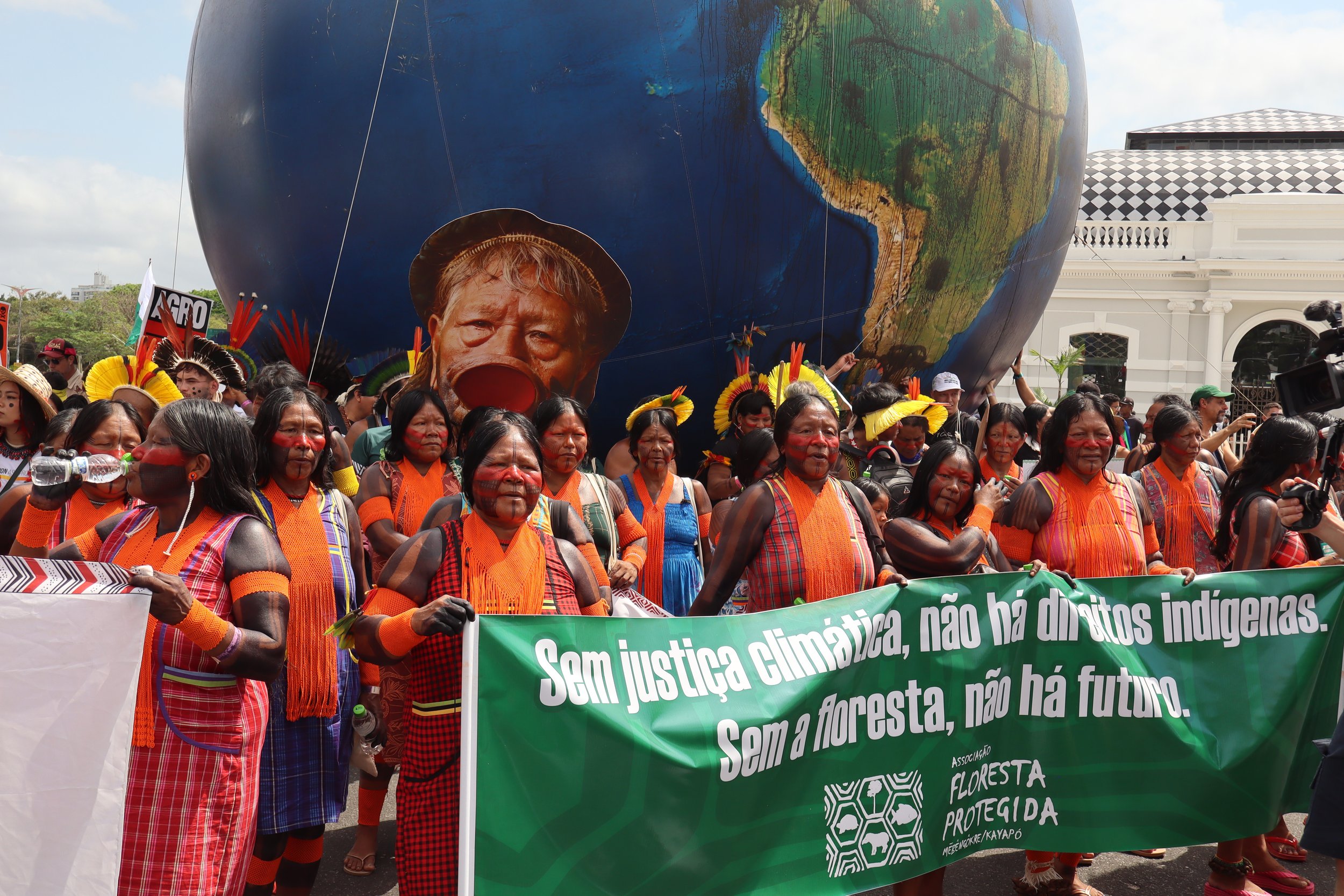


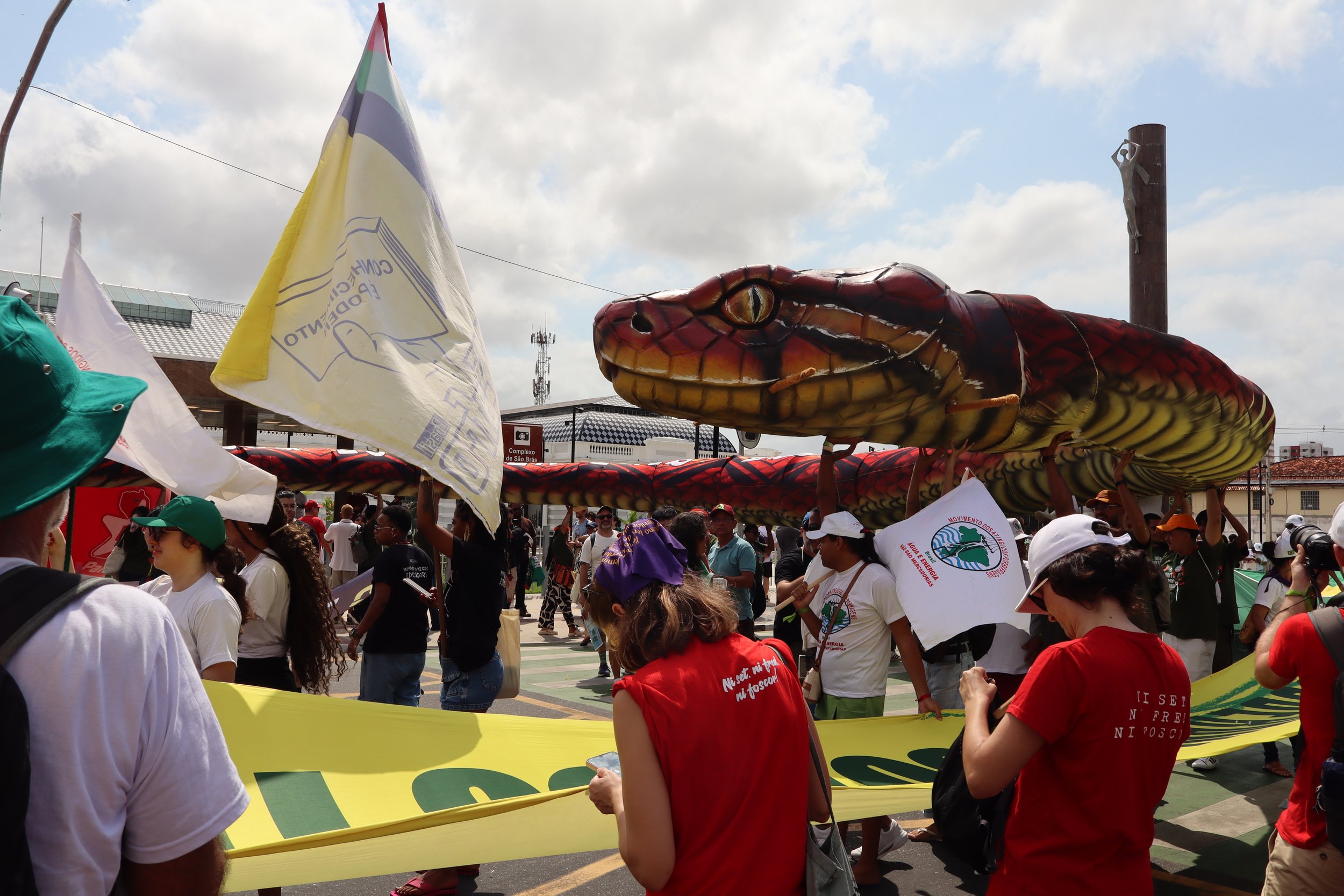
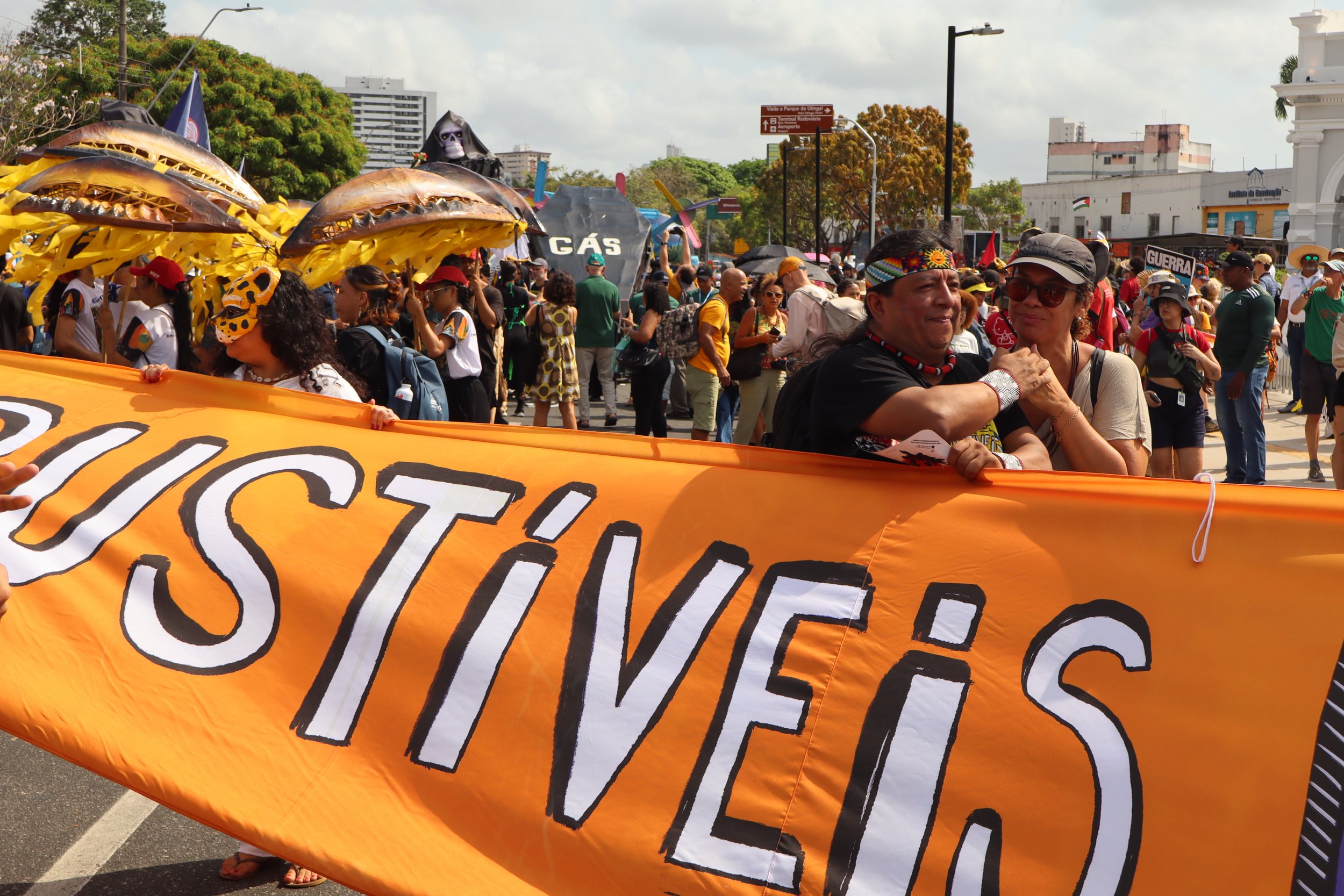

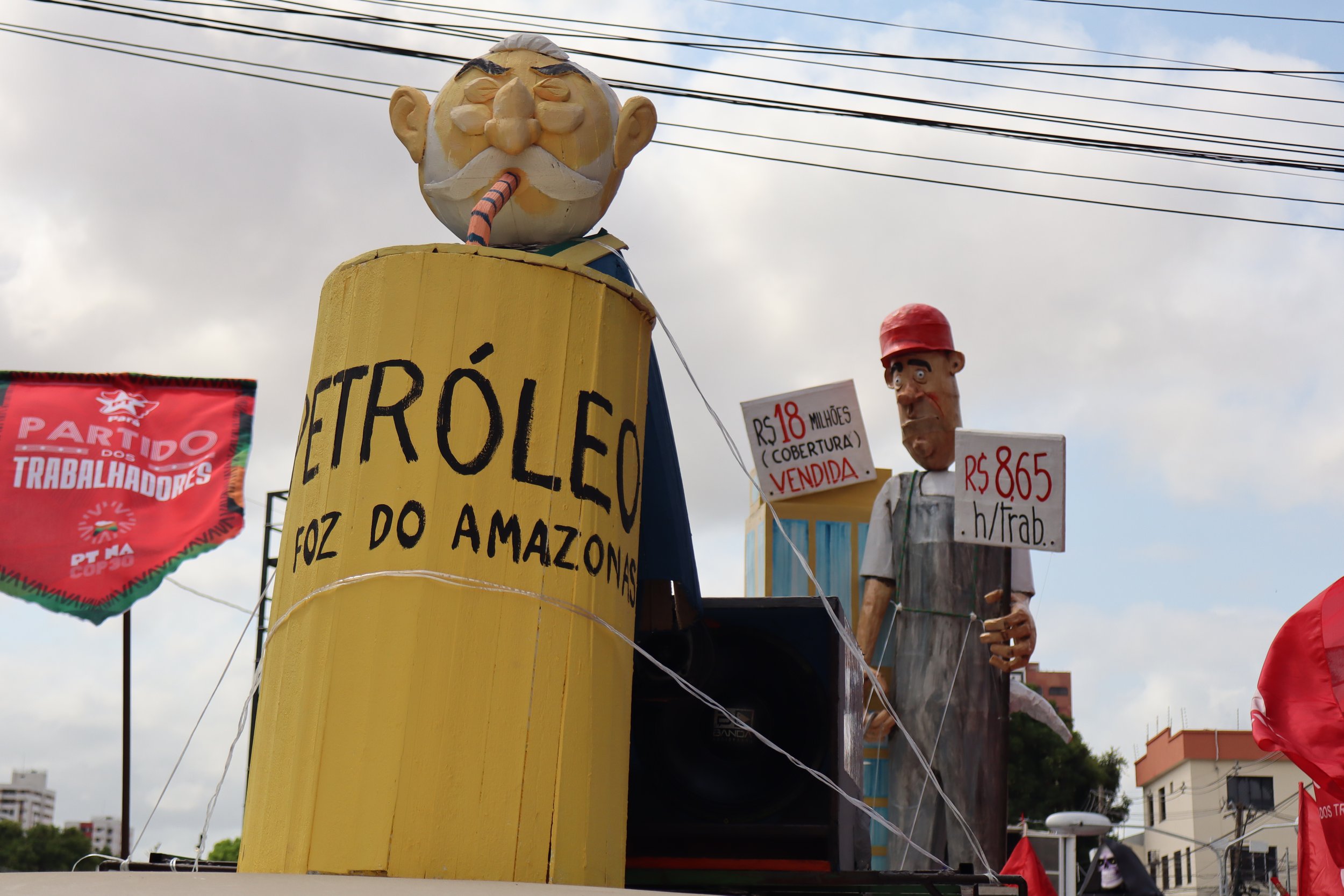
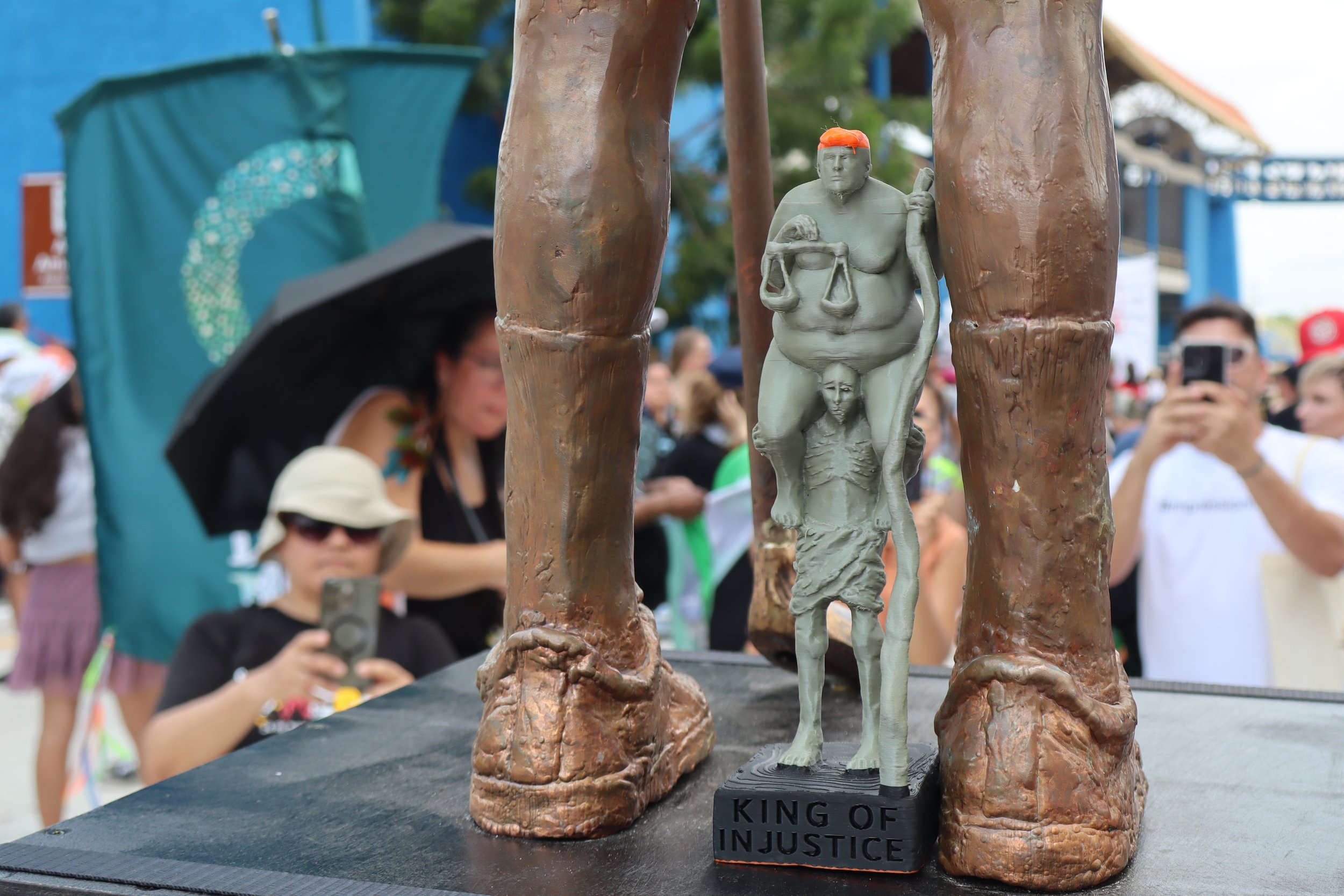
On November 15th, Belém was filled with chants and painted bodies marching from the São Bras market to the Amazon Village, next to the COP30 headquarters. It was probably the largest mobilization during COP30, bringing together 70,000 people. Indigenous delegations marched in blocks, firm and authoritative. Many carried messages directed at Petrobras and the Brazilian government. Others carried banners in solidarity with Palestine. The connection between struggles was not theoretical; it was lived on the hot asphalt of Belém.
The march was also a festival of vibrant colors, dances, traditional songs, and cultural expressions that reminded COP negotiators that the real world is outside the unstable, erratically air-conditioned rooms of the Blue Zone. The city transformed into the pulsating center of the fight against fossil fuel expansion.
The fight for critical biodiversity areas is global

Fossil fuels and biodiversity press conference, November 17, 2025. By Mirna Wabi-Sabi.
The most interesting aspect of COP30 has been the reinforcement of the fact that just as fossil fuel expansion is global, so is the fight against it. Avril De Torres, representative of CEED (The Center for Energy, Ecology, and Development) in the Philippines, highlights that the world has already passed the first major climate tipping point—the mass death of warm-water coral reefs. Warming is intensifying deadly typhoons and destroying coastal life cycles. Southeast Asia concentrates a large part of the world's marine ecosystems (corals, mangroves, coastal areas), becoming the epicenter of the crisis.
"The Coral Triangle, which is the global center of marine biodiversity, is our own Amazon of the Ocean, the Green Island Passage. But today, our waters and our people are under attack... Across Southeast Asia, 43 gigawatts of coal and 136 gigawatts of gas remain in the planning stages, and many more oil and gas blocks are still planned for exploration. Many of them are located within or dangerously close to protected areas, conservation zones, and critical habitats... Our government remains unable to hold accountable the fossil fuel development company that is also behind the largest oil spill in the history of Philippine seas, which occurred right in the Green Island Passage."
There are several striking parallels between the expansion of fossil fuels in the Verde Island Passage (VIP) in the Philippines, often called the "Amazon of the Oceans," and the expansion in the Amazonian terrestrial biome in Brazil. Both scenarios involve exploration in areas of critical megabiodiversity, direct threats to the livelihoods of local and indigenous communities, and a lack of governmental and corporate accountability. It is clear that current fossil fuel plans remain a critical environmental concern, not only in Brazil.
On the altar of consumerism


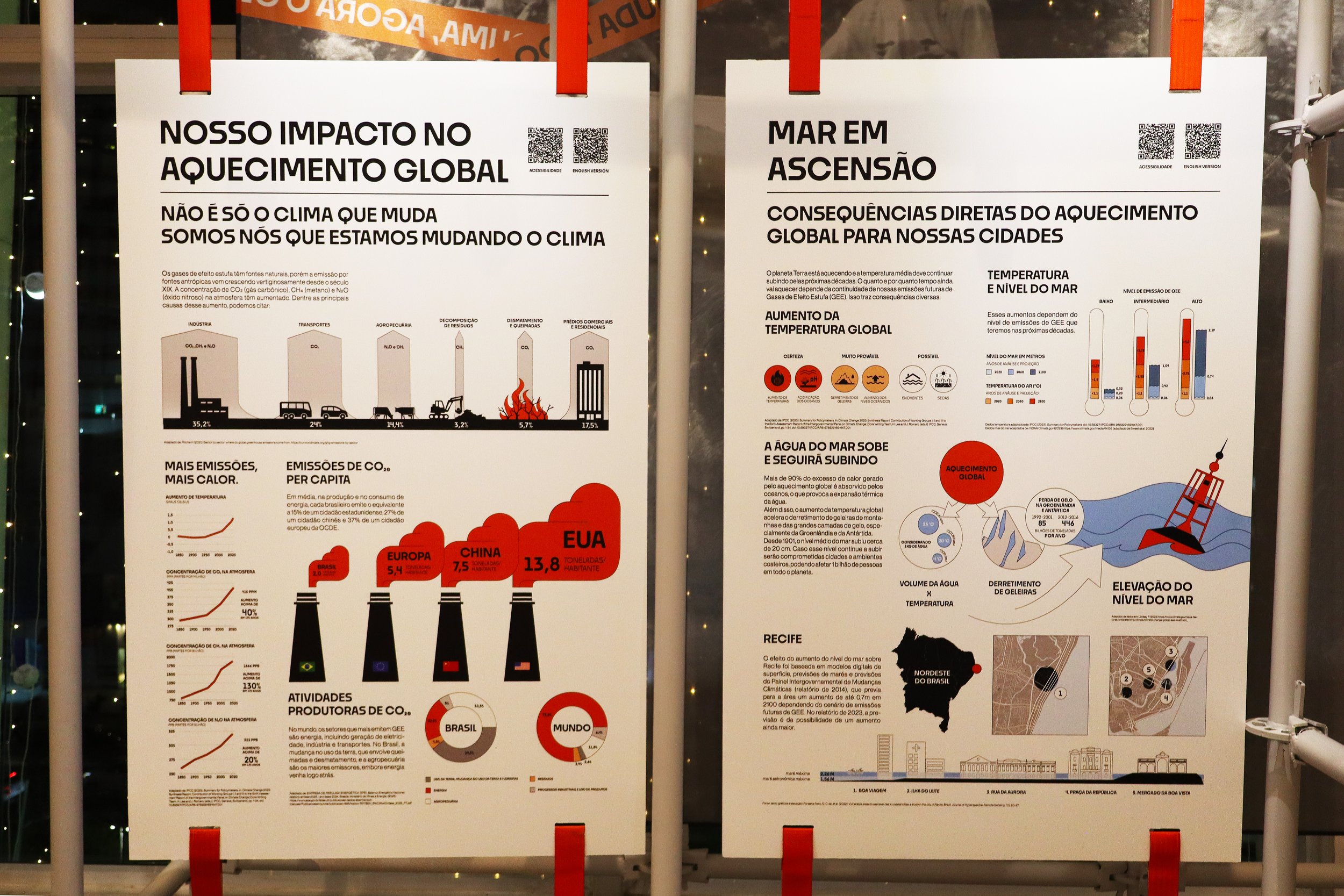


Redagua is a Guanabara Bay (in Rio de Janeiro) water conservation network—a network of environmental organizations funded by Petrobras in the area where the company is headquartered. During COP30, none of them were present, with the exception of an exhibit in a shopping mall food court.
On the altar of consumerism, this network's message was generic and, of course, did not address the expansion of fossil fuel exploration in Brazil. According to the exhibit, Brazil is doing quite well in this area compared to the rest of the world, using renewables for half of its energy source. Of course, Petrobras is not held responsible for the fact that this percentage is not higher.
Even when the argument is made in favor of an energy transition against dependence on fossil fuels, it is difficult to trust the narrative disseminated with funding from the company that profits most from fossil fuel exploration in this country.
This reveals how Petrobras shapes the environmental narrative, occupying public spaces while avoiding confronting its central role in the climate crisis. It also shows how initiatives funded by the fossil fuel industry itself produce narratives that dilute responsibility and neutralize criticism.
Ultimately, it highlights the risk of allowing a major agent of destruction to also be the curator of solutions—a conflict of interest that distorts the debate and compromises the very notion of a just transition.
Restoration and Reparation

Avril De Torres and Klara Butz, by Mirna Wabi-Sabi.
What can we expect from fossil fuel companies? According to Klara Butz of Urgewald, a German group that researches coal companies, and Avril De Torres of CEED, there is no way to avoid conflicts of interest in environmental funding from these companies. Any funding from fossil fuel companies is inherently compromised because it legitimizes expansion. They claim to fund ‘energy transition’ while more than 90% of the business remains fossil-based. Supporting a conservation project while expanding drilling in blocks like Block 59, an oil exploration area in the Amazon River Mouth Basin, is incompatible and contradictory. The risk of spills in sensitive areas (with mangroves impossible to clean) makes the argument of ‘environmental financial return’ absurd. Arguing that it is in the interest of environmental organizations that Petrobras continues to profit because with that profit it invests in conservation is an aberration.
Accepting resources from companies like this opens the door to more destruction. According to the interviewees, Petrobras bought Block 59 from Total Energies because it knew that, under Lula's administration, it could have the political backing to attract more companies to explore. Once authorized, the block becomes a gateway to a larger wave of buyers.
Any money from fossil fuel companies should only come as reparations, not as sponsorships.
That is, to immediately stop destructive operations and pay for environmental rehabilitation, health, and affected livelihoods. It is unacceptable to operate and ‘compensate’ simultaneously. Investing in conservation while destroying the core ecosystem is a paradox, and the only legitimate way to receive resources from these sources is through restoration and reparation.
Belém Sparkled
COP30, both inside and outside the Blue Zone, showcased a multifaceted, complex, and contested Brazil.
Within the Blue Zone, we see technical debates, protocols, slow negotiations, ambiguous declarations, and critical views as well, even if restrained. There was international solidarity with Palestine; oil workers exposing truths that governments avoid telling; scientists, artists, and social movements celebrating the power of the living Amazon. Outside the zone, there were songs in Tikuna, Yanomami, Kayapó, and Kichwa; Indigenous youth denouncing oil; and thousands of people from Brazil and around the world demonstrating.
Belém sparkled in the impossible encounter between so many cultures, languages, and territorialities, in the conviction that there is no future within the fossil fuel age. Indigenous peoples showed that it is not only possible, but urgent, to declare territories forever excluded from exploitation, as Melva and Jonas say. And they reminded the world that there is no just transition without dismantling colonial structures, be they oil platforms in the Amazon, illegal oil-fueled settlements in West Asia, or spills in the Green Island Passage in the Philippines.
The beauty of Belém is not merely aesthetic; it’s also political. It affirms that life and nature, when defended collectively, must prevail.
Final Notes / References
Jonas Reis de Castro, press conference “ClimaInfo Institute: The Beginning of the End of the Fossil Fuel Era at COP30”, November 14, 2025. Translated excerpts from the transcript.
Melva Patricia Gualinga, “Amazon Watch: Amazon Free from Extraction: Ending Oil, Gas, Mining & Agribusiness on Indigenous Lands.” Translated excerpts from the transcript.
Oil Change International, Press Conference on Fossil Fuel Shipments to Israel, November 13, 2025. Speeches on the use of oil in genocide.
Leandro Lanfredi, National Federation of Oil Workers (FNP). Speaking about Petrobras' responsibility and indirect exports to Israel.
Avril De Torres, CEED, Fossil fuels and biodiversity, November 17, 2025. Exclusive interview with Avril De Torres and Klara Butz, November 17, 2025.
Helder Barbalho, and other speakers at Aldeia COP, 6 PM, November 18, 2025.
Mirna Wabi-Sabi

Mirna is a Brazilian writer, editor at Sul Books and founder of Plataforma9. She is the author of the book Anarcho-transcreation and producer of several other titles under the P9 press.